It does what now?
Yep this was once the future of your home. A garbage can sized rolling bunch of nothing. Check out it's amazing memory and fine voice simulation.
They always come back:
A laundry list of failed CONsumer friendly robot prototypes have since been unleashed on the world. The most anticipated and failed is Honda's Asimo
Newton
Sam's Seafood.

Sequoia Sempervirens.: Sam's Seafood.
They Always Come Back:
Sam's is no more. It has now become Kona. The building still stands but the new owners could care less about it's tiki background let alone the history of this establishment.
Vintage ads.


Click an image in order to superimbigulate.
Via
Thank you Christy for sharing these fine ads. I'm speechless.
I just want to say that the picture of Joe Conrad is my new favorite image.
Anita Bryant
Family values and Florida go hand in hand. No other person embodied those two things more than Anita Bryant. Anita showed us that with a little vitamin c and a lot of hatred in your heart you too can be a winner.
Bryant was crowned Miss Oklahoma in 1958 and was a second runner-up in the 1959 Miss America beauty pageant at age 19, right after graduating from Tulsa's Will Rogers High School.
In 1960, she married Bob Green, a Miami disc jockey, with whom she eventually raised four children, including Gloria and Robert Jr. (Bobby).
Her three biggest pop hits were: "Till There Was You" (1959); "Paper Roses" (1960) (successfully covered 13 years later by Marie Osmond); and "In My Little Corner of the World" (1960). She placed a total of eleven songs in the Top 100.
In 1969 she became a spokeswoman for the Florida Citrus Commission, and nationally televised commercials featured her singing "Come to the Florida Sunshine tree" and stating the commercials' tagline: "Breakfast without orange juice is like a day without sunshine". Here she is in all her beauty.
In 1977, Dade County, Florida (now Miami-Dade County) passed a human-rights ordinance that prohibited discrimination on the basis of sexual orientation. Anita Bryant led a highly publicized campaign to repeal the ordinance. The campaign was waged based on what was labeled "Christian beliefs regarding the sinfulness of homosexuality and the perceived threat of homosexual recruitment of children and child molestation."
Her view was that "What these people really want, hidden behind obscure legal phrases, is the legal right to propose to our children that theirs is an acceptable alternate way of life... I will lead such a crusade to stop it as this country has not seen before." The campaign was called 'Save Our Children', the start of an organized opposition to gay rights that spread across the nation. Jerry Falwell went to Miami to help her.
Bryant made the following statements during the campaign: "As a mother, I know that homosexuals cannot biologically reproduce children; therefore, they must recruit our children" and "If gays are granted rights, next we'll have to give rights to prostitutes and to people who sleep with St. Bernards and to nail biters." On June 7, 1977, Bryant's campaign led to a repeal of the anti-discrimination ordinance by a margin of 69 to 31 percent.
The fallout from her political activism had a devastating effect on her business and entertainment career. Her contract with the Florida Citrus Commission was allowed to lapse in 1979 because of the controversy and the negative publicity generated by her political campaigns and the resulting boycott of Florida orange juice.
Her marriage to Bob Green failed at that time, and in 1980 she divorced him, although he reportedly has said that his fundamentalist religious beliefs do not recognize civil divorce and that she is still his wife in God's eyes. Some observers feel that her husband pushed her to get involved in the political activism that eventually led to her downfall and loss of income. Kathie Lee Gifford, who worked as a live-in secretary/babysitter for the Greens in the early 1970s said in her autobiography that Green had a ferocious temper and could be very possessive and emotionally abusive and that Anita was not very happy.
Due to her divorce, many fundamentalist Christians shunned her. No longer invited to appear at their events, she lost a source of income. With her four children she moved from Miami to Selma, Alabama, and later to Atlanta, Georgia. In a Ladies Home Journal article she said, "The church needs to wake up and find some way to cope with divorce and women's problems."
She now lives in Edmond, Oklahoma, and says she does charity work for various youth organizations while heading Anita Bryant Ministries International.
They Always Come Back:
Florida still hates Gay folk. Anita has revived her career. She returned to her high school in Tulsa on April 21, 2007, to perform in the school's annual musical revue.
Colorforms
Colorforms, invented by Harry Kislevitz, are toys produced by the Colorforms Corporation. Colorforms are paper-thin, die-cut vinyl sheet images and shapes that can be applied to a slick cardboard background board, much like placing paper-dolls against a paper backdrop. The images stick to the background via static cling and can be repositioned to create new scenes. The original box sets began appearing in the 1950s and feature bright shapes and "modern" basic designs, expanding into cartoon character sets. Later Colorforms licensed various properties, producing box sets supporting various TV series and movie releases.
(via wikicrapedia)
They Always Come Back:
Colorforms are now classified as an educational toy. You can fine them here.
I Hop
Possibly the most infectious jingle ever. Acid induced family fun!
Hell is open for business. Stuck in this commercial hell Timmy gets a plate of offal and shy lil' Suzy gets a cockpot that instantly stirs up memories of inappropriate touching. Mom gets sliced tomatoes and Crisco on a bed of greens as Dad enjoys testicles marinara for all eternity.
Oh those wary faces.
Oh that suspicious food.
I like the way the family is introduced running to Ihop and then, after they see that crap on the table, they are shown running away from Ihop.
Ihop is everywhere man.
Based in Glendale California Ihop has 1,344 locations across the country.
They will be a future subject on this blog. I cant see the number of pancake houses increasing. I'll wait them out. They have to fall out of favor sometime. My favorite is the one near Fisherman's Wharf in San Francisco. I once watched a lovely drunk prom date throw up into a bus-tray and when she was all done she made out with her handsome date. The busboy didn't get to see her throw up but he did pick up the bus-tray a few moment later and gagged as it was full of orange juice glasses and warm Bacardi smelling vomit.
"Vintage" Halloween Costume

You never know what you are going to get when you yell "Trick or Treat" wearing this Village People outfit.
Bosco

Once the rival of Hershey’s, Bosco has virtually disappeared from grocery shelves in California. Bosco, mmmm, Bosco. Chocolaty goodness in a bottle. Add it to milk, pour it on ice cream, take it straight from the bottle for a chocolate rush the makes your elbows pulse with chocotricity. Bosco, poured on zombies for that "just right" blood look in Night of the Living Dead . Bosco, (Not Hershey’s) was poured down the drain when Marion Crane attempted to wash away her sins and head back to Phoenix at dawn... then Mother intervened.
Bosco, the medium of choice for artist Vik Muniz when he decided to paint the last supper. Bosco Bosco BOSCOOOOOO!
Bosco, first created in New Jersey in 1928 survived the great depression, WWII, the Korean war, Vietnam, The gulf war but sadly not the Terminator era. I guess Cal ee for ni ans just dont like chocolate.
Bosco is unique as a chocolate syrup since it has only natural cocoa with no artificial flavors added. No corn syrup is used in the production of Bosco, only cane sugar. Malt extract is added, which combined with Bosco cocoa powder yields the distinctive Bosco taste.
Bosco was once packaged in glass jars, but, more recently sold in plastic squeeze bottles.
One good thing that came out of New Jersey. Bosco!
They Always Come Back:
Bosco is sold in two supermarket chains in California:
How's Markets and Stater Bros . If you cant find either of these stores try Bosco Online.
The Ditto Machine

A spirit duplicator (also referred to as a Ditto machine ) was a low-volume printing method used mainly by schools and churches. The term "spirit duplicator" comes from the alternative term for alcohols, which is "spirits." Alcohols were a major component of the solvents used as "inks" in these machines. The spirit duplicator was invented in 1923 by Wilhelm Ritzerfeld. The best-known manufacturer in the United States was Ditto Corporation of Illinois, hence that name.
A ditto machine used a solvent like methylated spirits or ammonia to transfer ink from the master copy (the template, if you will) onto other pieces of paper.
The master copy was a smooth, waxy piece of paper which was thickly inked when printed. The procedure for printing on a master was like the reverse of a carbon-copy; instead of writing on the normal paper and having the carbon underneath, the text and pictures were printed onto carbon paper of varying colours to transfer print to the master. If you want to know exactly how thickly a master was inked, put your printer on the best quality and print about two or three passes onto the same sheet of paper (so that you are printing over the previous printing, I mean).
The master was then wrapped around a drum, and the solvent was applied as the drum rotated. The solvent either softened or melted the ink so that just enough of it would stick to the blank sheets of paper. A lot of the copies produced in this way came out with purple ink because purple “provided the best contrast” As you can see in the following photo Ditto copies were far from easy to read.
Both the isopropanol and the methanol found in ditto solvents are toxic substances. These chemicals can cause a host of medical problems when humans are improperly exposed. Material Safety Data Sheet (MSDS) guidelines recommend the use of personal protective equipment during exposure to methanol, however, most chemists work with methanol and isopropanol wearing only medical exam grade gloves, goggles and a working fume hood as the chief, no-ingested or inhaled reaction with methanol is limited skin irritation.
Ditto machines were popular in schools and churches as no electricity was needed to make quick stinky copies. Nothing smells quite like a fresh slightly wet Ditto copy.
They have gone the way of the typewriter and the dictaphone.
They Always Come Back:
Thanks to the efforts of this site they are not forgotten.
Libbyland Dinners
Boy the 70's sure were great. Kids got to eat what they wanted. Too bad what they wanted actually tasted worse than school food and left you feeling dirty and ashamed.
Libbyland Dinners were one of the worst meals made for kids. But... as a kid, ya gotta try it. After all, it offers up pirate fun and who eats better than pirates? Oh yea... everyone.
Libbyland Dinners, manufactured by Libby of course, were made in the early 1970's around the time McDonalds had their McDonaldLand campagin. In a time where the HungryMan dinner reigned supreme it was a breath of fresh frozen air to see a meal designed especially for kids. Too bad it offered up some creepy food. Artificial grape flavored scalding applesauce was my favorite! Each meal came with a package of powdered Pink Strawberry Quick-esque mix. Not a meal for the Sabbath but eh... its a meal.
These frozen meals featured fantastic pop-up packaging that would provide minutes of fun while you choked down the partialy edible meal. The front pop-up panel featured hidden pictures ala HIGHLIGHTS for Children.
This meal distraction was perfect for kids trying to hold back tear of disgust as they chowed down the vulcanized burger or "Fried Parrot" (It was really fried chicken but damn, it was a tough ol' bird.)
Not only did these dinners entertain you while eating they provided motivation to finish the prison-type food by embossing pictures into the bottom of the TINfoil tray. "Eat it all and you'll see the monkey!" If I heard that now I'd call the police and asked to be put in a foster home. It's amazing to think that a simple drawing of an animal actually motivated children to eat. Here, now, in this future we live in, the only way a kid would eat slop is if there was a free download code at the bottom of the tray or perhaps a picture of Pete Wentz's's's wiener.
They Always Come Back:
They are gone forever but crappy food marketed to kids is big.
Libbyland Meals were the granddaddy of Kraft Lunchables. If you want to know just how bad Libbyland meals were just pick up one of these kids meals and enjoy the moment that occurs 10 minutes after you eat it, when your mouth starts stinging and you taste benzine.
Sensurround

In the history of movie gimmickry, which includes The Tingler Electroshock, Smellovision and 3-D, Sensurround is by no means the least effective or the most offensive. Like its predecessors, it was seriously defined as an attempt to break through film's customary sensory limits. More honestly, it was a means of luring the credulous into paying good money for a bad picture. Sensurround consisted of nothing more than a bank of woofers that emit low-pitched rumbling sounds, causing the theater to vibrate in a mildly alarming manner whenever earth tremors are seen to move, shake and ultimately destroy Los Angeles.
(click on the above image to get an idea of what viewing a Sensurround film looked like. Enough to give you a headache eh?)
Sensurround was Universal Studios proprietary system that premiered with the 1974 film EARTHQUAKE. The system did not fair well. During its initial release, with the film Earthquake, theater owners were subjected to a $500.00 a week rental fee plus they has the dubious honor of being guinea pigs in a grand experiment. The low frequency signal produced by the system could not be contained within the theater. During this time many older theaters had been remodeled and it was common for a single screen theater to be split into two theaters. That split meant there were side by side theaters with a common wall. That common wall could never contain the fury that was Sensurround. The Godfather II was released at the same time and was booked into the same houses as Earthquake. The vibration was so distracting that theater owners were forced to make a decision and it was not in favor of the $500.00 a week fee. Theater owners who stuck it out had other problems too. The Gruaman's Chinese Theater had to install a net below the ceiling to ensure bits of the old plaster and woodwork did not rattle loose and fall on patrons. Several theater adjacent stores reported damage from the system. A mall pet store reported that mall bound theater system killed its goldfish. It was a disaster tailor-made to accompany a disaster.
Here is a section taken directly from the Sensurround sound installation manual:
"The Sensurround Model II system developed by MCA Universal brings a new dimension to the motion picture theatre. It is designed to generate special audible and sub audible effects not yet possible to reproduce on presently available systems. The audience will actually be participating in the film. The torso will vibrate. So will the diaphragm. Flesh and auditory nerves will receive the sensations one might feel while experiencing the event depicted on the screen. Rather than the structure-shaking resulting from a natural disaster, this vibrating movement is actually airborne. Although some vibration can be felt - on thin wall surfaces, the amplitude is so small that no appreciable displacement can be measured. Also, the Sensurround effects will not cause hearing damage. The system is composed of high-level electro-acoustic with solid-state power amplifiers capable of up to 1000 watts of audio power. The system develops 100 to 120 dB sound pressure level (SPL) on the "C" scale in the theatre. "
Universal made sure the system would work no matter what type of film you were projecting. 70mm magnetic or 35mm optical, Sensurround worked. It took its cues from markers on the film. 
It was a system that could awe but it had its flaws. One man suffered a cracked rib from the system. Other people fell ill. Nausea and vomiting were common.
Also... it seemed that the Sensurround system, if it were on a musical scale, emitted "the brown note." It could rattle your bowels clean. Yet another reason why theater owners frowned on the system.
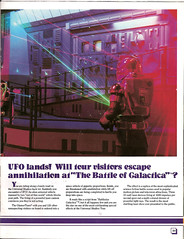
It was used on only four films Earthquake (which won an Oscar for sound) Midway, Rollercoaster and, its last gasp, Battlestar Galactica.
The only two surviving Sensurround systems are currently at Dolby Laboratories.
They Always Come Back:
There will always be some sort of gimmick added to films. Ride the current 3-d wave if you must. If you want good old fashioned shaky gut rumbles buy the EARTHQUAKE DVD (The one released 2006) and enjoy its SENSURROUND 3.1 technology. You can also check the store for Sensurround products.